Sculpting itself is a joy. Every time. The real trouble always starts when I move on to casting. Much as I love learning, making the mould and casting anything complex is, well, complex. A hard problem in the strict, engineering sense. Very often I start off not knowing where the gaps in my knowledge are, bumping my head and my ego quite thoroughly and repeatedly, dusting off and trying again.
In the many collaborative spaces and studios I have worked over the years, this specific experience seems to be universal. The only thing I have seen that separates success from failure is the capacity to learn from errors and feedback, and the tenacity to persist.
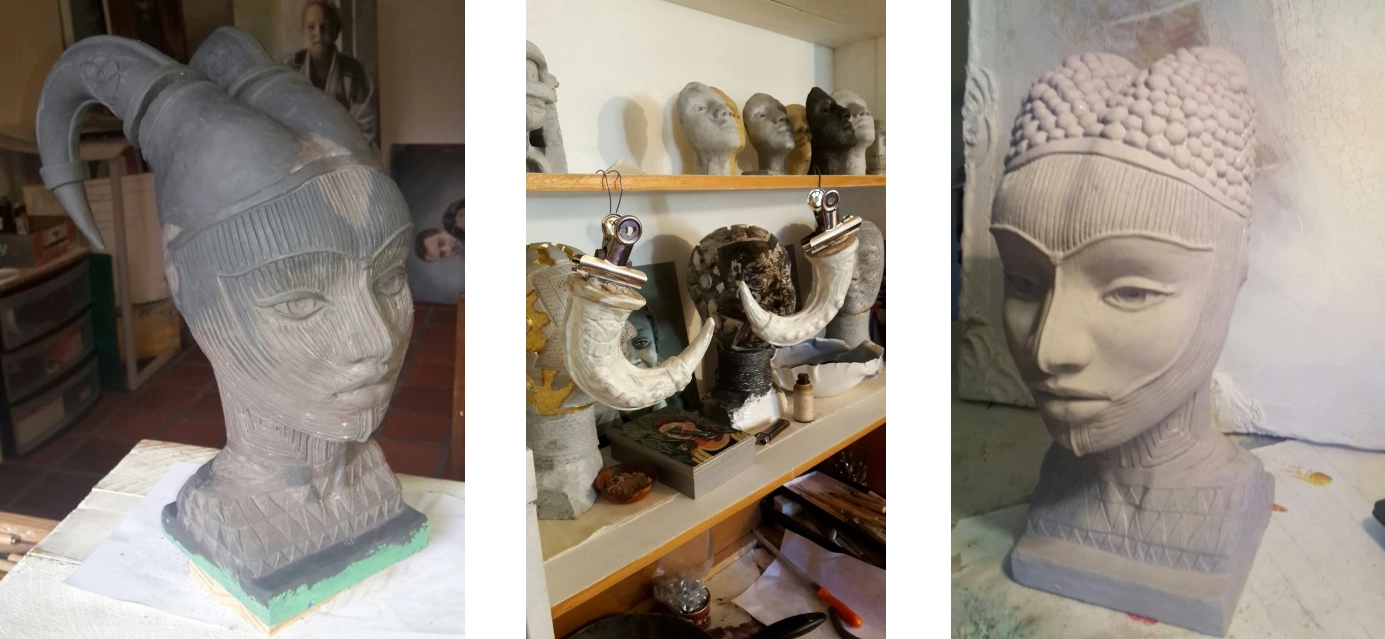
Carving lines into sulphur-clay, Layers of latex drying on the horns, and a slightly dispirited forest spirit, primed and ready for the mould.
I had foolishly been getting oil-based clay that contains sulphur until very recently, and having to spend ages priming every crease of the original sculpture before making the mould. The thing is that both natural rubber latex and silicone rubber moulding materials absolutely loath sulphur-based clays. Natural rubber hates it because the oils in the clay leech into the rubber as soon as the water has evaporated, and this disintegrates the rubber, turning it into a soft, crumbly mess. Silicone, by contrast, simply refuses to cure in the presence of sulphur so it stays sticky and runny and messy indefinitely. Worse, it’s impossible to wash off with either water or solvents because it’s oil-based. This means that water runs off it and does nothing, while turpentine or other solvents dissolve the clay of the sculpture itself, along with the silicone.
So the cure to the cure is priming. Any acrylic or curing, water-based binder does a good enough job, providing it isn’t full of chalk fillers that would wick the oils and allow even a whiff of them to touch the rubber. In the end, sulphur clay really isn’t worth it and I know my best results come when I just invest in the best materials I can find and afford if I have any hope of valuing my time.
I carefully dis-assembled the protrusions, to be moulded and cast separately. Concave surfaces are notoriously hard to mould and cast, so the best-practice for thousands of years has been to cast complex artworks and machinery in pieces, and assemble them all at the end. De-horned and de-eared, the forest spirit looked less spirited, but ready for the next step.
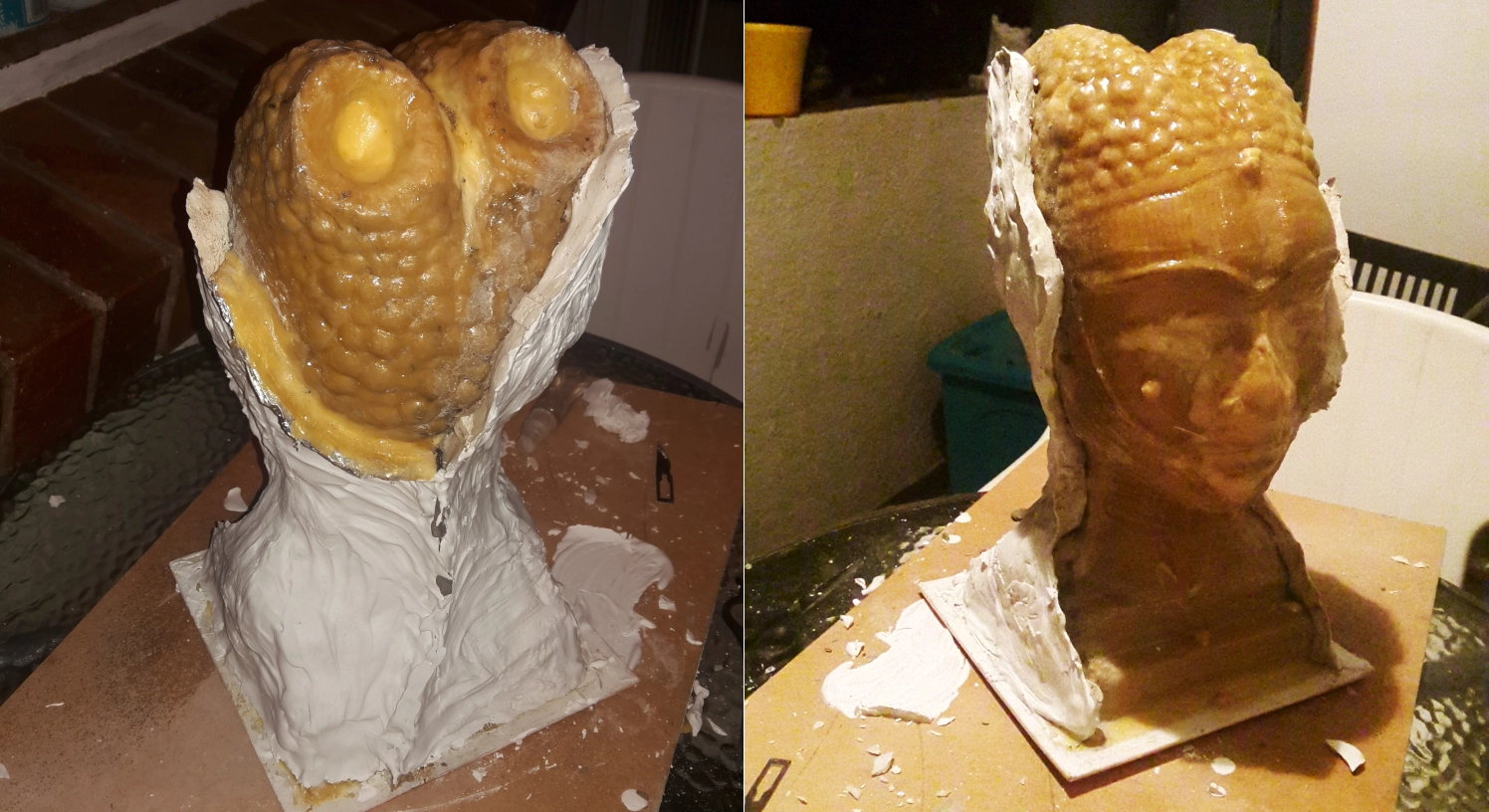
Natural latex and the cast-stone mother mould
I love using natural latex, especially for small sculptures because it is non toxic and also incredibly flexible and strong. This piece was bigger than could practically be held upright in an entirely rubber mould though, so definitely needed the support of a mother mould. Otherwise I would have still been painting latex layers well into my 90’s.
I originally made the mother mould with polyester resin and fibreglass. It’s cheap enough to experiment with and I’d used it on smaller pieces many times. I forged ahead boldly with a 3-piece mother mould and almost instantly realised it was a horrible, horrible mistake. As I tried to remove the first piece of the polyester, I realised that the lumpy sculpture had been made lumpier by the latex in a few critical places. Everything was wedged in and I had to painfully bend the rubber-covered sculpture to free it. Worse, the polyester, now freed from the constraints of its contents, proceeded to warp. Feeling defeated, I spent about a week staring blankly off into space and busying myself with commissions while I tried to think my way out of physics.
Eventually I surrendered to the inevitability of modern materials and a more complex approach with a gypsum-filled acrylic resin. Also known as “cast stone”. It’s a remarkably strong, calcium-aggregate resin composite that is much heavier than polyester and fibreglass, but far more stable, far less toxic and really quick and clean to work with. Expensive? Yes, but given how far I had come and with exhibitions upcoming, it was absolutely the right choice.
Smooth sailing was still many headaches away though. I’d left hollow sockets where the horns attached onto the head thinking this would make reinsertion easy and allow me to add plenty of connectors and adhesive resin to the gap, thus ensuring a good bond. This would have been perfectly intelligent if I had managed to make sensible, flat cuts - and if I’d not horribly damaged the insertion points while extracting the rubber-covered sculpture from the polyester. Looking back, it would have possibly been less painful to simply carve some holes in my own skull. As it was, I patched up the original and muddled along with my first test-casting. I haven’t been able to find any pictures of the disaster but they might have upset sensitive readers so it’s probably just as well.
The simple problem throughout the whole first and second attempt is that latex gets annoyingly thin when it dries, but not evenly thin: it is eminently lumpy and gets ever more so with subsequent coats. so that even with 20 coats it hadn’t filled the detailed undercuts on the chin and inside the stupid horn holes. The fix, I discovered later, is to stick small pieces of latex-dampened cotton-wool or gauze in strategic places. on small moulds, this gives you a freestanding mould that captures exquisite detail and pulls neatly off even the most improbable shapes. After the debacle with the polyester I made some improvements using latex-soaked cotton-wool but: it takes an age to dry through, and latex also doesn’t stick well to itself after a few days of curing so not much could be amended on this try without delamination.
This meant I had to make the mother mould in 6 pieces. Unbelievably, everything fitted beautifully, but: The next disaster came when I had to remove the mould after the first casting in hard resin and pulling it off took hours because the rigid mother-mould, even divided as it was into six segments, was still almost completely wedged into the undercuts, making release impossible without judicious use of the chisel. Also, in the process of slush-casting the thin wall of the latex pulled away from the mother mould and warped the neck a little. I was very proud of myself for not smashing everything up to use as calcium for the vegetable garden.
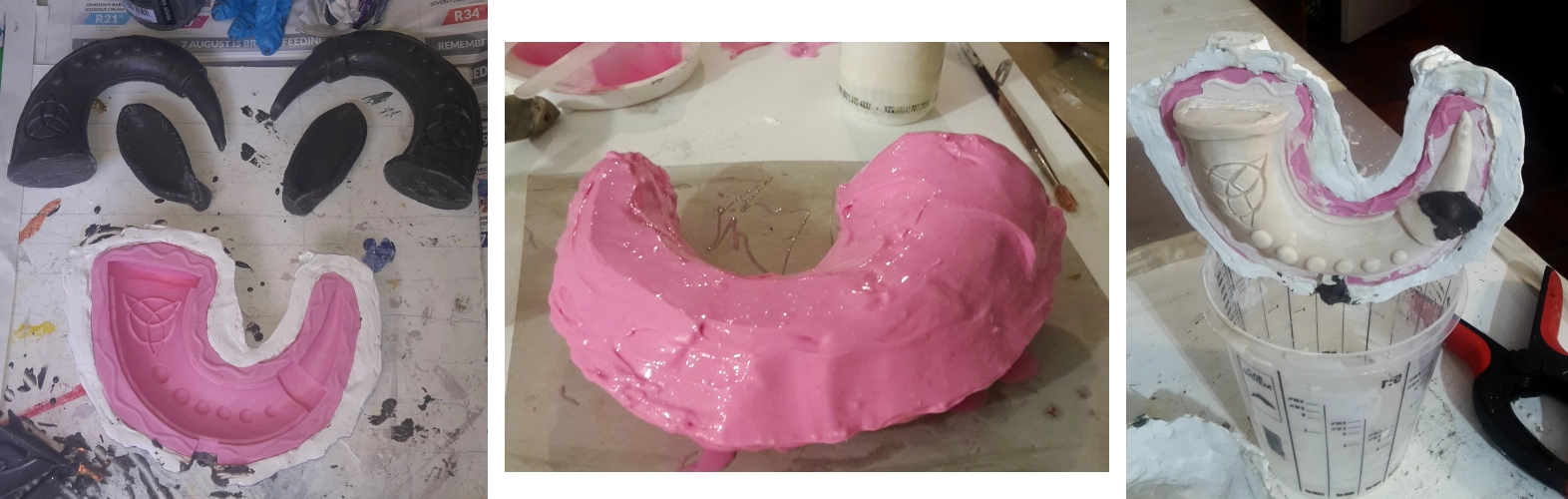
Surrendering to silicone
By the time I had the good sense to just use silicone I had already damaged the original sculpture trying to remove the first polyester support, so I foolishly, and not for the first time, decided to “fix it in post”.
(Note: Never fix it in post. Most people have fun answers to the question of what to do with a time machine. I should never be entrusted with this as I’d casually rip holes in quantum probability to fix every “fix it in post” decision I make in my studio. It would break from overuse in a week and I’d never have travelled further back in time than 48 hours)
Silicone
As mentioned earlier, Silicone has a different but equally terminal hatred of sulphur-clay. So after tenderly repairing all the dents and scratches from de-moulding from the latex, I re-primed and painted on the first layers of unthickened silicone. Once that looked stable enough to handle more robust treatment, I mixed a bigger batch with thixotrope and trowelled it on with a pallet knife. I don’t understand why people don’t use pallet knives for more things. I made an entire YouTube video about this. Here is a link to that video.
This, finally, was the “smooth sailing” part I had been dreaming of, mostly: I realised after the fact that I’d left myself a hole at the base of the horn for pouring in the resin or cement but the curve of the horn meant that I’d be fighting bubbles and gravity with every pour. Sensibly, I sealed up the bottom (thankfully silicone sticks fanatically to silicone and not much else), and I cut a new pouring hole at the mid-point which worked beautifully. If I filled it up past the ridge-line, I could just hand-shape the extra material to match the curve.
Finally, finally I poured more of the wonderful acrylic resin into the completed mould pieces and, an hour or so later, got to pull my perfectly cast pieces into the world. Final assembly went surprisingly smoothly and I was delighted with the casting. The agony of failure overwritten by the reward. I am sure the next piece will be easier, at least, that is what the dopamine circuit tells me.
Still, I continue to learn and it’s not like I can stop now. There’s no 12 step program for curiosity.